What Paint Correction Actually Removes, and Why It Is Not a Yearly Job
Paint correction levels the clear coat. That is why it is done carefully, and why you should not do it every year.
October 27, 2026 · 4 min read
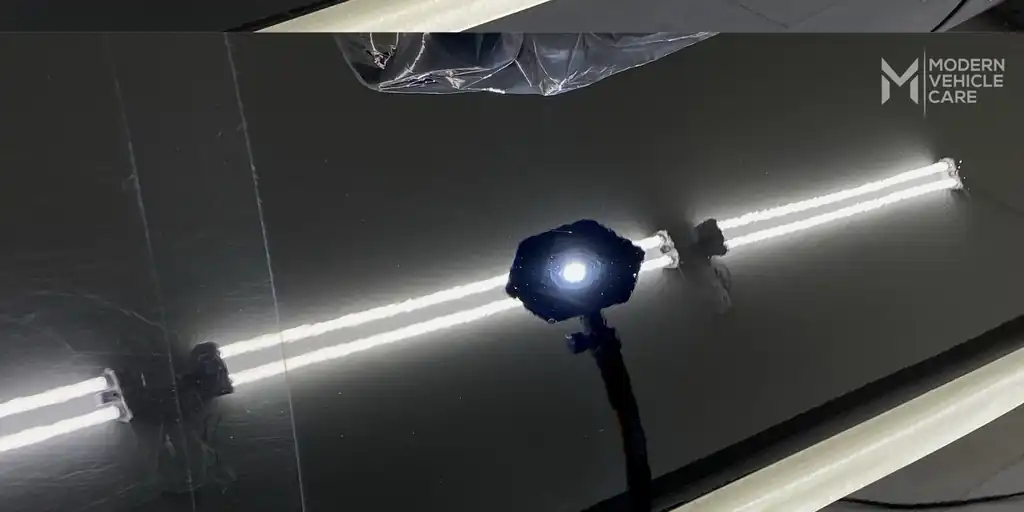
Your car's paint is more than color. On top of the color sits a layer of clear coat, and that clear layer is what gives paint its depth and shine. It is also the layer that gets scratched, every time the car is washed, wiped, or brushed against.
Paint correction is the process of leveling that clear coat so the scratches are gone instead of hidden. Here is what it removes, how it works, and why it is not something to repeat every year.
Swirls, holograms, and marring
Swirls are fine, circular scratches. They come from drive-through washes, dirty wash mitts, and drying with the wrong towel. In direct sun or under a strip light they look like spider webs across the paint.
Holograms are a rainbow-like haze that polishers sometimes leave behind when the work is rushed or done with the wrong pad. Marring is light scuffing, often from someone wiping the car with a rough cloth.
All three are the same basic problem: the surface of the clear coat is no longer flat, so light scatters instead of reflecting cleanly. That is why dark cars show it worst.
How Modern Vehicle Care does it
The paint correction here is a multi-stage exterior detail. The steps, in order:
- pH balanced foam hand-wash.
- Chemical paint decontamination, which removes 99% of bonded contaminants.
- Aggressive clay bar.
- Inspection under multiple high-lumen detailing lights, with sensitive areas taped.
- 3-stage machine compounding and polishing, which cuts through 95% of surface imperfections.
- Deep wheel and tire cleaning, windows cleaned, tires dressed.
Each panel gets at least 30 minutes per stage. New polishing pads are used for each stage, and every microfiber that touches the car is brand new and discarded after use. One vehicle is worked on at a time.
How to tell if your paint needs it
Take the car out of the garage on a sunny day and look at the hood from a low angle. Swirls look like fine circles around bright reflections. On a dark car they are hard to miss. Now try the same thing under a gas station canopy at night. If the paint looks dull and busy instead of clear and deep, correction will make a big difference.
You can also run a clean hand over the paint after washing. If it feels rough or gritty, that is bonded contamination. That is why the decontamination and clay steps come before any polishing.
Why the order of steps matters
Polishing a car that still has bonded dirt on it drags that grit across the paint and makes more scratches. So the wash, chemical decontamination, and clay bar come first. Only when the surface is truly clean does the machine work begin.
The slow pace matters too. At least 30 minutes per panel per stage is a lot of time on a single door or fender. It is how you remove the defects without cooking the clear coat with heat or pressure.
Why it is not a yearly job
Correction works by taking off a very thin amount of clear coat so the surface is flat. The clear coat is a finite layer. Take it off too often and there is nothing left to protect the color underneath.
That is why the shop says plainly that correction can only be performed a limited number of times per vehicle. Once the swirls are out, the job is not to repeat the polish. The job is to keep the paint from picking up new ones.
What correction cannot fix
Correction levels the clear coat. It cannot rebuild paint that is already gone. A scratch deep enough to catch your fingernail may have gone through the clear coat, and polishing will only soften its edges. Rock chips, peeling clear coat, and faded or failing paint are separate problems.
A good shop tells you which marks will come out and which will not. Send photos with your quote request and ask directly.
How to keep a corrected finish
- Skip the automatic car wash with spinning brushes.
- Wash by hand with clean mitts and plenty of water, and never wipe a dry, dusty car.
- Dry with a clean, soft towel, not an old bath towel or a chamois you dropped on the ground.
- Ask about ceramic coating after correction, which makes the finish slicker and easier to wash.
Cost and booking
Paint correction starts at $599 for a Coupe or Small Sedan. Paint correction is quoted by email. Send a few photos of the paint and your make and model to ModernVehicleCare@gmail.com, or call (203) 893-6425. The shop is by appointment only and every job is drop-off.
Modern Vehicle Care, (203) 893-6425
Call (203) 893-6425More articles
Why Headlights Turn Yellow, and Why Shelf Kits Bring It Back
The cloudy amber on your headlights is not dirt, and polishing alone does not fix what caused it.
Lifetime or One-Year Headlight Restoration: Which One Your Car Can Get
Two warranty tiers, two prices, and a list of makes that can only get the lifetime one.